Ants. It was ants that brought me to LabLit.com.
I cannot recall the year I joined Twitter (remember that?), but it was when it was still an interesting place to be. I originally joined for work – to promote the University College Library library where I was working – but I made a personal account at the same time. Not being a scientist (at least in the employed or trained sense, though I consider I am in the sense that I just want to know), I enjoyed the fact that one could interact with Actual Real Living Scientists and that they would often reply.
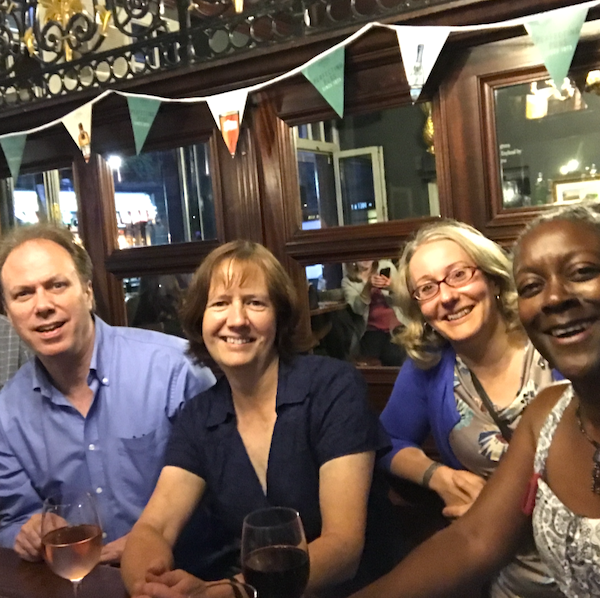
Social media turns out to be a brilliant way for scientists to communicate their work, and even to involve ordinary people in their research in the form of ‘Citizen Science’ projects. These allow the public to provide basic data on a mass scale that a small group of researchers could never acquire on their own. Soon after I joined Twitter, I noticed a post from Dr. Rebecca Nesbit, an entomologist by training who was working for Society for Biology. She was advertising a Citizen Scientist project that the Society was running in collaboration with fellow entomologist Dr. Adam Hart to see if there was any truth in the idea that ordinary black ants (Lasius niger) shared a common day for their mating flights. When the Society and Adam held an event, I attended and got to know Rebecca, who was at that time an early member of LabLit.com’s official London ‘Fiction Lab’ reading group, which met monthly at the Royal Institution to discuss novels about scientists. In January 2015, she convinced me to come along. (That’s her in the picture with me, chatting afterwards in the King’s Head.)
At that point, I did read the odd bit of fiction, but was more interested in factual things, such as popular science, history, and natural history. The first book I read with the Fiction Lab group was – it turned out – not very “lab lit”. Someone in the group had suggested Somerset Maugham’s The Painted Veil (1925) based on its back-cover blurb, which mentioned that the main character was a bacteriologist and physician. Unfortunately, the novel didn’t make the cut to be considered proper lab lit, or even ‘lab lit lite’ – which has happened from time to time over the reading group’s 17-year history.
My experience reading The Painted Veil was frustrated further by its odd semi-religious ending. When I raised this during the discussion, everyone else was baffled; we soon realised the edition I was reading had been expurgated of its grittier, more downbeat ending by the Christian publisher of my copy! Such discrepancies were far from unusual in a group where the books were sourced far and wide, from libraries and book shops to Amazon and second-hand re-sellers. On another occasion, we were reading Lily King’s Euphoria, which I enjoyed, but my hardback edition talked about sloths (a species confined to the Americas), while the novel was set in New Guinea! It turned out that everyone else had the paperback where this had been corrected to a quoll. Don’t get me started: I think I have a very different idea of what basic general knowledge is than most people. But getting those details right is important. While I enjoyed Beyond the Door of No Return by David Diop, it had eucalyptus trees in West Africa, at a time when they had only just been discovered in Australia.
Regardless of any niggling irritations in the books we read for Fiction Lab, I was hooked. There were a few hundred books in the lab lit genre on the List, but I started looking for new ones. I hope you all know by now, but lab lit must feature a major (not always the main) character who is a scientist (our Dear Leader allows mathematicians) in a plausible scientific setting. This means it excludes a lot of science fiction, most dystopian novels, and also some that encompass past, present, and future, like Maja Lunde’s recent novels. For better or worse, at some point I evolved (in Jenny’s words) the website’s official “lab lit sniffer”.
Genre is a chimaera. No artist is identical with another in style, most lab lit authors are unaware of the concept and are just writing a novel, and everyone has a different perception of what they are reading. Ultimately whether or not we decide to consider a particular book for the List is down to what we can glean from reviews, blurbs, and a crafty butchers in the bookshop; but deciding whether it truly makes the cut requires someone to read nominations from cover to cover – often “taking one for the team” if the nomination is particularly bad writing – and successfully making the case. I started suggesting books to Jenny and the reading group. Then, rather than a scattergun approach of firing off emails or tweets to Jenny every time I saw something, which then would get lost in her thousands of emails, I began to compile an online candidate list that we could use to promote anything suitable to the official Lab Lit List once or twice a year, when our Dear Leader managed to find a moment for her feet to touch the ground.
Consequently, I search book reviews in the newspapers, and systematically go through new publication shelves on book shops, to see if they might be suitable for inclusion. As I am sure we might have missed some books published years ago, so browsing all sorts of books in charity shops or libraries is useful. In fact, that was how I discovered the H.G. Wells novel Ann Veronica. The problem is, it is not always clear a book is lab lit, until you read it. It is a truism, but the editor’s decision is final.
There seems to have been an increase in the number of novels that fit the lab lit model (see the companion piece here), but it is difficult to know if this is due to the ‘availability heuristic’, or is rather a real increase. I tend to think that the perceived increase is real. I created a spreadsheet of novels on the List, and tried to find out more about the authors. There is a clear increase in the number of female lab lit authors; there are quite a lot who have studied science to a degree level and a smaller number who have been working scientists. But you do not need to be an expert to write a decent lab lit novel; you only have to write well – thrillers, crime, romance, family sagas, literary novels, horror and everything in between.
You find it, or write it, we’ll try to read it!